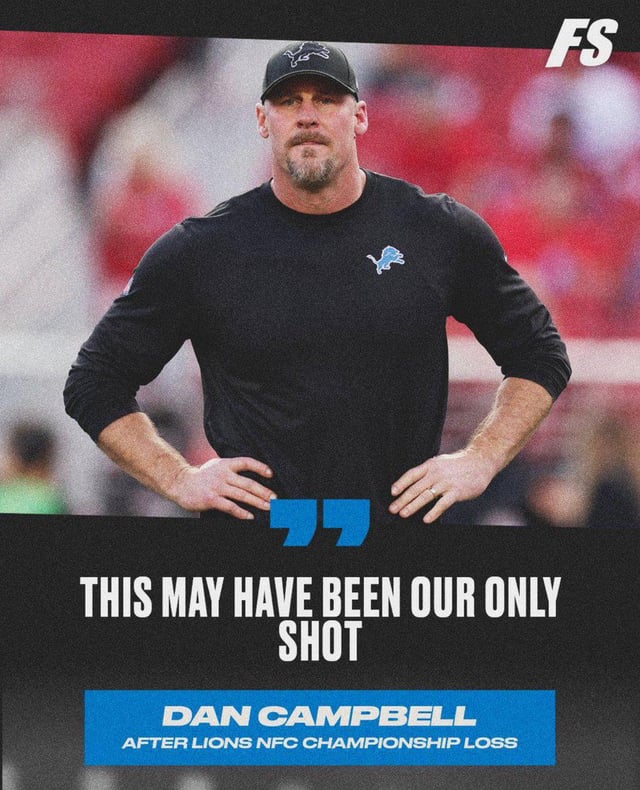
Dan Campbell stood in front of the media after the Detroit Lions fell short in the NFC Championship and said something that stuck with a lot of people:
“This may have been our only shot.”
At the time, the quote felt pessimistic. Fans didn’t want to hear it. Detroit was young, exciting, and seemingly just getting started. The assumption was simple: this team would be back.
But Campbell understood something most people didn’t want to admit.
He wasn’t saying the Lions’ window was closed.
He was saying that version of the Lions had reached its peak.
The Lions That Shocked the NFL world.
The Lions that fought their way to the NFC Championship weren’t supposed to be there. They were ahead of schedule, they were the overachievers.
A gritty roster built through patience by general manager Brad Holmes and molded by Campbell’s relentless “knee biting” culture. Players like Alex Anzalone, Aidan Hutchinson, Jared Goff, David Montgomery, Jahmyr Gibbs, Penei Sewell and Amon-Ra St. Brown helped transform Detroit from a rebuilding franchise into one of the toughest teams in the league.
They weren’t considered the most talented roster on paper or the moat experienced.
But they were hungry.
They were playing with something to prove.
Detroit had spent decades being the punchline of the NFL. Suddenly, the Lions were biting kneecaps and punching contenders in the mouth. Opposing fans weren’t happy. The little brother had finally grown up and fought back.
That version of the team played with the energy of a Cinderella story.
And Campbell knew Cinderella stories rarely last forever.
Why Campbell Was Right
The NFL doesn’t stand still.
Contracts expire.
Veterans age.
Free agency reshapes rosters overnight.
The Lions that shocked the league were built on a mix of young stars learning the NFL way and veteran culture-setters who carried Detroit through the early rebuild.
Players like Anzalone helped establish the identity of the locker room. He was the voice of the defense and a captain who embodied Campbell’s mentality.
But even foundational players eventually move on. Anzalone’s departure in free agency marks the symbolic end of that original rebuild era as he signed a two-year deal with the Tampa Bay Buccaneers.
Taylor Decker wanted out after 10 years as one of the faces of the Lions.
David “Knuckles” Montgomery requested a trade.
And he wasn’t the only change.
Cornerback Amik Robertson left for the Washington Commanders, further reshaping Detroit’s defense.
A year prior, Kevin Zeitler opted to return home in Tennessee.
The once strong culture that was built has seemingly taken a hit….but it hasn’t.
It’s ’s being tested.
The culture built by Dan Campbell and general manager Brad Holmes hasn’t disappeared. But the Detroit Lions are entering the stage where culture stops being a slogan and starts being a responsibility for the next wave of players.
The culture that revived the Detroit Lions and helped transform Detroit from a franchise known for losing into one known for toughness, accountability, and belief.
Ironically, success is what challenges culture the most.
When the Lions were rebuilding, the locker room had a shared identity: Prove everyone wrong. Fight through adversity. Play for each other
No excuses.
Nobody believed in them.
Now everyone does.
Suddenly the team that used to play with house money is being discussed as a Super Bowl contender. That shift changes the psychology of a locker room.
The new pressure becomes:
Protect the reputation
Live up to expectations
Handle national attention
Veterans leave.
Young players take bigger roles.
Expectations rise.
That’s where the Lions are at now.
Culture isn’t something you install once and forget about. Every offseason chips away at it.
The new era of the Detroit Lions began in 2026 started when Detroit began retooling the roster to prepare for its next phase.
The Lions ushered out the old guard and began moving towards their future, which is now the present.
The Lions signed center Cade Mays to a three-year deal to help rebuild the offensive line.
The early Lions rebuild was about proving Detroit belonged.
This is about expectation.
The Lions are no longer the scrappy underdog trying to earn respect. They are now viewed across the NFL as a Super Bowl contender.
That changes everything.
Teams game-plan differently.
Opponents circle Detroit on the schedule.
The pressure shifts from surprise success to championship expectations.
The young players who once supported the veteran leaders are now becoming the leaders themselves.
Nowhere is that transition more symbolic than at linebacker.
For years, Alex Anzalone anchored the defense and helped guide the culture.
Now the torch has passed to Jack Campbell.
Campbell represents the next generation of Lions.
This next era of Lions football won’t look the same as the one that reached the NFC Championship.
It can’t.
The original group had something powerful fueling it: the hunger of being overlooked.
That chip on the shoulder drove Detroit’s rise.
But now the Lions are expected to win.
The franchise is no longer chasing respect.
It’s chasing Lombardi trophies.
And that’s why Dan Campbell’s quote still resonates.
He wasn’t doubting the future of the Detroit Lions.
He was acknowledging something deeper:
That magical run belonged to a specific group of players at a specific moment in time.
That team had its shot.
Now a new one must take its place.
The Lions entering this next phase are different.
They are deeper.
They are more talented.
And they are built to sustain success.
But the responsibility now falls on the next generation of players to carry the culture that the veterans built.
The Anzalones laid the foundation.
The Jack Campbells must now defend it.
Because in Detroit, the rebuild is over.
The era of expectations has begun.


 The West Coast Lion!
Leave a comment