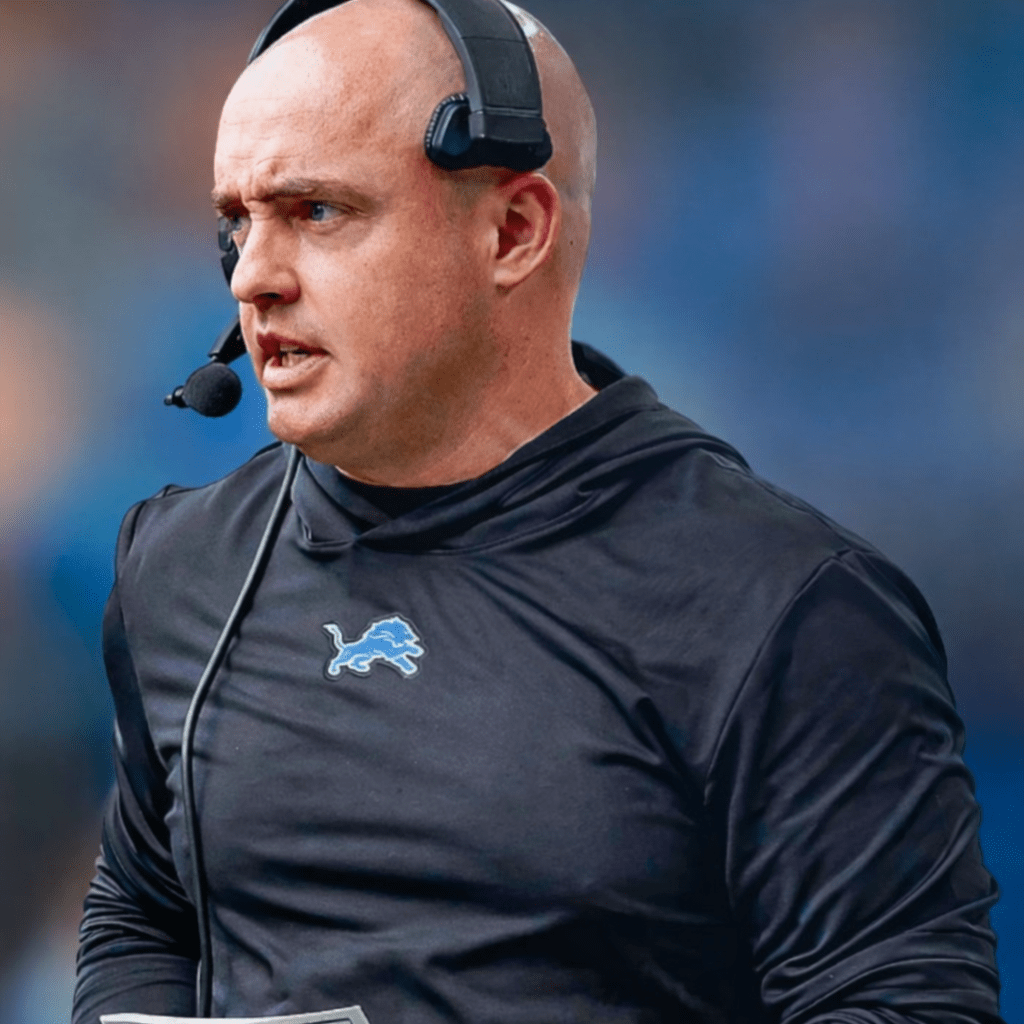
Is the criticism for new Lions Offensive Coordinator warranted?
There’s a lot of noise online right now trashing Drew Petzing because the Cardinals went 3-14 last season and some fans think he’s a reckless or terrible play-caller, adding that he is predictable has boring play selections and a lack of situational awareness with those playcalls.
That’s a very surface-level reaction — and it ignores the real context that actually defines a coordinator’s performance.
Coaching Doesn’t Happen in a Vacuum — Especially Not in Arizona
A lot of the criticism assumes Petzing was drawing up perfect scripts in a clean environment. That couldn’t be further from reality:
Quarterback chaos: Kyler Murray only played five games last year before Jacoby Brissett was thrust into the job for the rest of the season. That’s not a “script failure,” that’s a roster catastrophe. When your highly paid former 1st round pick franchise QB is replaced (either from injury or performance), that’s a recipe for disaster.
Offensive line disaster: Arizona’s line repeatedly collapsed, having multiple starting rotations, tons of different starters for games and zero consistency, leaving Petzing with no running lanes and constant pressure. That kills any chance to have sustained drives, no matter who is calling plays.
Injuries: Running backs, receivers, and offensive linemen all missed significant time. Petzing never had a stable group to implement his concepts consistently. It’s nearly impossible to set up any gameplan other than your 15 play script and even then, good luck trying to get anything substantial.
You can’t fairly evaluate an OC’s scheme or decisions without accounting for the roster he had to work with.
One bad season in a broken situation doesn’t erase a decade of work. The idea that Drew Petzing suddenly forgot how to coach is lazy fan logic.
Petzing’s Resume Actually Shows Growth, Not Random Chaos
Before Arizona, Petzing spent over 10 years in the NFL working his way up:
Offensive assistant roles where he learned system structure. Tight Ends coach where he emphasized fundamentals and efficiency.
Quarterbacks coach, where his focus was decision-making and timing
Then offensive coordinator — earned, not gifted.
Guys don’t get that many roles across multiple staffs if they’re clueless. The league quietly weeds those people out.
Arizona’s offense actually progressed before it collapsed and that part gets ignored because it doesn’t fit the rage narrative.
When the Cardinals were healthy:
The offense moved the ball, the run game was productive, efficiency metrics improved, James Conner had career-level production in Petzing’s system. That doesn’t happen by accident or “despite” the OC.
Fans judge offenses by explosive passes.
Coaches judge them by:
Down-and-distance success
Run efficiency
Ability to stay on schedule
Petzing built a physical run identity, play-action concepts tied to it and a clock-control approach.
That’s not sexy. It is functional — when the roster supports it.
Detroit values that exact profile.
The league doesn’t hire “bad” coordinators into good situations
Here’s the cold reality fans don’t want to face:
Good organizations don’t bring in coordinators they think are incompetent — especially when:
The roster is ready, the window is open and expectations are high
Detroit didn’t hire Petzing as a lottery ticket. They hired him because his philosophy matches Campbell’s, he understands structure and he can operate inside a collaborative system.
Bad coaches bounce downward. Petzing moved laterally into a better environment. That tells you what the league thinks of him.
Fans confuse “didn’t work” with “can’t work”. Something not working in Arizona doesn’t mean it can’t work elsewhere.
NFL history is full of coaches who failed in bad situations then thrived with stability and talent.
Petzing’s résumé shows steady progression, his offenses weren’t fundamentally broken. The run game and structure were real.
The collapse came from injuries and instability and Detroit sees value where fans see failure.
Calling him “trash” because Arizona went 3-14 is emotional, not analytical.
A lot of fans treat Petzing like a random guy with no track record. That couldn’t be farther from the truth. Petzing has been in the league over a decade, coaching multiple offensive positions — from assistant roles to tight ends coach, quarterbacks coach, and then coordinator. He’s had his hands offensive schemes all over the league.
When the offensive unit was healthy in 2024, the Cardinals were top-15 in scoring and overall offense, with strong efficiency metrics. And that’s with a weaker roster than the one he’s inheriting in Detroit.
In his first two seasons, Arizona boasted one of the best rushing yards per carry averages in the league, and James Conner had back-to-back 1,000-yard seasons under his system (a first in Conners career) — something that hasn’t been done since Edgerrin James in 2006 and 2007.
Petzing was interviewed for head coaching jobs and ranked among the top NFL coordinators by analysts entering 2024. That perception doesn’t change easy inside league circles because other coaches, GMs and owners see things differently and more in depth than fans usually do.
That’s not a resume of a coach who “just runs random plays.” That’s a guy who built real facets of an offense and earned respect from peers.
Play-Calling Isn’t a Dictatorship — Especially in Arizona Last Year
A huge misconception is that Petzing “called all the shots, however he wanted.”
That’s not how NFL offensive coordinator works, especially under a head coach like Jonathan Gannon who’s defensive-minded and naturally more conservative as most defensive coaches tend to be. They play the field position game and trust their area of expertise to hold the line. In Arizona, scheme decisions were shared, and strategic agreements happened up the chain. It wasn’t Petzing operating autonomously.
Criticisms like “he ran on third-and-long too much” miss the bigger point: you don’t know if that was what the head coach actually wanted or if it was even feasible with the roster they had. Teams are playing the pass in 3rd and long situations so by trying to throw you’re taking a bigger risk of turning the ball over and giving your opponent a shorter field to work with. We’ve seen in Detroit, the Lions hit on these draws and screens because of the athletes they have.
The biggest myth fueling the Petzing backlash is the idea that the OC just grabs a headset, ignores everyone else, and freelances for 60 minutes.
That’s fantasy. An offensive coordinator’s job is not to “call whatever he wants.” His job is to execute the head coach’s vision. Risk tolerance, tempo, how aggressive to be with leads. When to take chances and when to live for the next series
If the head coach is defense-first, the offense will reflect that, no matter who the OC is.
Jonathan Gannon is a defensive coach. His background screams don’t lose the game, win the field position battle and cause the opponent to make mistakes.
That mindset bleeds into offensive decision-making — whether fans like it or not.
Here’s something fans rarely understand: many “controversial” calls aren’t decided in the moment.
They’re agreed on during the week:
3rd-and-long philosophy, red zone priorities, two-minute risk thresholds, backed-up offense rules.
So when fans scream:
“Why would he call that there?!”
There’s a strong chance that call was pre-approved or outright mandated or it was the only option allowed in that scenario. Much like when a QB audibles.
Gannon likely had more influence than people admit. Defensive head coaches don’t suddenly stop caring once the offense takes the field.
Time of possession, field position, avoiding short fields, not putting their defense back out immediately will lead to:
Conservative calls
Safe plays
Punt-friendly decisions
If you think Jonathan Gannon didn’t weigh in on those things, you don’t understand power dynamics in the NFL or football on general.
OC autonomy shrinks fast when: you’re losing, the roster is thin and the head coach is trying to survive the year.
“But he was the OC — it’s his fault” is lazy logic. Yes, the OC is responsible.
No, that doesn’t mean he controlled everything.
Blaming Petzing alone ignores:
Head coach influence, game-management decisions, roster limitations and injury realities.
It’s easier to blame the guy calling plays than to admit the structure itself was restrictive.
If fans truly believe Petzing was calling plays completely unchecked in Arizona, then they also have to believe Jonathan Gannon was asleep on the sideline.
He wasn’t.
Petzing wasn’t freelancing. He was operating within a defensive-minded framework with limited tools.
You can hate the results — that’s fair.
But pretending he was some rogue play-caller doing whatever he wanted is just wrong.
Comparing Petzing to Ben Johnson Isn’t Fair
A lot of fans trot out “Ben Johnson had full freedom with the Lions” as if that’s a benchmark Petzing failed to hit and its false.
In Detroit, Ben Johnson didn’t operate as the lone voice of offense either — he complemented Dan Campbell’s overall philosophy and was trusted specifically because Campbell liked what Johnson’s scheme did within his framework. He also would include QB coach Mark Brunell and OL/Run Game coordinator Hank Fraley. Let’s not forget WR coach Scotty Montgomery and RB coach Tashard Choice. It’s a collective effort from everyone involved and ultimately lays at Dan Campbell’s feet. It’s his offense, his team.
Likewise, Petzing won’t be parachuted in to “do his own thing” in Detroit. He’ll install concepts that align with Dan Campbell’s vision — run-heavy, play-action based, efficient balanced football — with collaborative input from the head coach.
This idea that Ben Johnson was some rogue genius operating independently is fan fiction. The reality is Ben Johnson reported directly to Dan Campbell.
Game plans were collaborative, not unilateral.
Campbell had final say on:
Aggressiveness thresholds
4th-down decisions
Clock management
Risk tolerance
Johnson didn’t call plays that conflicted with Campbell’s philosophy — he executed it.
The reason it felt like “full freedom” is because:
Johnson and Campbell think the same way, just look at the playoffsand how many times Ben went for it on 4th down. Campbell trusted him.
The roster allowed creativity to actually show up on Sundays. Freedom comes from alignment, not absence of oversight.
Trust is earned through results AND roster stability
Ben Johnson didn’t walk into chaos.
He inherited a top-tier offensive line, a QB who processes quickly and skill players who win matchups.
That lets you: Expand the call sheet, get cute without getting killed and call deeper-developing concepts.
You don’t get Ben Johnson freedom in that environment — you get handcuffs.
Talent, Context and Philosophy Matter
Everyone acknowledges the Cardinals roster was flawed:
Weak or injured OL
No consistency at WR
Backup QB most of the year
Top offensive minds still struggle to win with those conditions. That’s not a Petzing deficiency — that’s football.
Even some fans on Reddit argue that the Cardinals offense’s failures are about context more than a single coordinator’s calls — and others point out the system actually produced good rushing numbers and progress when healthy.
You shouldn’t trash a coach’s career based on one bad year in a brutal situation. The data shows Petzing has real accomplishments and wasn’t simply a “bad caller” by default.
Petzing had real offensive success in Arizona before injuries and instability derailed the results.
Petzing’s resume is long and varied, with respect from around the league.
The “he’s trash” takes are loud — but they’re lazy. The real picture is far more nuanced, and the Lions’ decision to hire him isn’t as reckless as some are claiming.
This is the part Cardinals fans and media don’t want to sit with, because it forces them to admit the problem is bigger than just one guy with a play sheet.
You cannot evaluate play-calling without roster reality. Play-calling criticism usually sounds smart but ignores execution reality.
Ask yourself:
What exactly is a coordinator supposed to do when:
The QB situation is unstable?
The offensive line can’t hold up?
The run game is decimated by injuries?
Your top receiving options either aren’t ready or aren’t separating?
At that point, you’re not calling the “best” play — you’re calling the least damaging one.
Fans say:
“Why are you running on 3rd and long?”
Coaches see:
– A QB who can’t get through progressions
– A line that won’t protect long enough for deep routes
– Receivers who aren’t winning vs the DB
– A defense playing the pass
That run isn’t stupidity — it’s damage control.
Another lie people believe is that coordinators chase creativity at all costs. They don’t. Defensive-minded head coaches (like Jonathan Gannon) prioritize:
Field position
Time of possession
Minimizing turnovers
Making the opponent drive the length of the field
That naturally leads to:
Conservative calls,
Runs or screens on 3rd and long,
“Live to fight the next series” decisions.
So when people blame Petzing for being conservative, they’re really criticizing and not understanding a team-wide philosophy.
And here’s the part that people really miss,
Dan Campbell does the same thing. He likes running on 3rd and long. He likes screens on 3rd and long. The difference in the calls is that Campbell trusts his offense to get the conversation, Gannon didn’t. He reverted back to his specialty, defense.
“He didn’t maximize MHJ”
This assumes MHJ was already elite. Fans wanted Marvin Harrison Jr. to be an instant WR1 game-breaker. That expectation doesn’t magically make it true. Reality is that rookie WRs struggle with: Route timing, Press coverage and NFL speed.
A bad QB situation magnifies those struggles.
A bad OL eliminates slow-developing routes.
So the real question isn’t:
“Why didn’t Petzing scheme MHJ open?”
It’s:
“Was MHJ ready to be schemed around with that roster?”
Because scheming only works when the QB can deliver on time, protection holds and the receiver wins consistently.
If any of those fail, the scheme stays the whiteboard.
Bad teams always blame coordinators first
This is league-wide behavior, not an Arizona-specific problem. When teams lose fans blame the OC, media echoes it and nuance disappears. But notice this pattern: Coordinators get fired, new coordinator arrives, same roster, same problems.
That’s how you know the issue wasn’t just play-calling.
Sean McDermott asking for more talent and getting canned proves the point:
Coaches know when the cupboard is bare. Fans pretend scheme can overcome reality
It can’t — not consistently
Detroit is the opposite environment
This is why the “he’ll fail in Detroit” takes are lazy.
Detroit gives him: A stable QB, proven skill players, and a head coach who shares his philosophy
That changes everything. While the OL isn’t the dominant force it was, it’s still better than what Arizona has and will surely be getting a good amount of attention in the offseason.
Petzing isn’t being hired to “save” an offense. He’s being hired to operate within a system that already works.
That’s when coordinators thrive.
The uncomfortable truth is the Cardinals didn’t fail because Drew Petzing is incompetent.
They failed because the roster wasn’t ready, the QB situation collapsed and the head coach’s philosophy limited risk, fans expected creativity to replace talent and while that is a small part of it, it can’t be the whole philosophy.
Calling Petzing “trash” is emotionally satisfying. It’s also intellectually lazy.
And if he succeeds in Detroit — which the structure strongly suggests he will — a lot of these same voices will quietly pretend they “always knew Arizona was the problem.”
Bottom Line
The backlash against Drew Petzing is loud, confident, and mostly wrong. It’s based on assumptions that don’t line up with how NFL staffs work, how rosters affect play-calling, or what Petzing’s actual résumé shows. What fans are reacting to isn’t reality — it’s a simplified villain narrative built off a 3–14 record and hindsight frustration.
Fans look at the play sheet and ask why the “best” play wasn’t called. Coaches look at protection, personnel, and trust levels and ask what the least damaging option is. Judging Petzing as if he were coordinating a stable offense is dishonest from the jump.
Dan Campbell and the Lions know what’s at stake here: Everything they’ve built.
If this fails, then it could cost people their jobs. They didn’t make this decision lightly or without research into the man they hired.


 The West Coast Lion!
Leave a comment